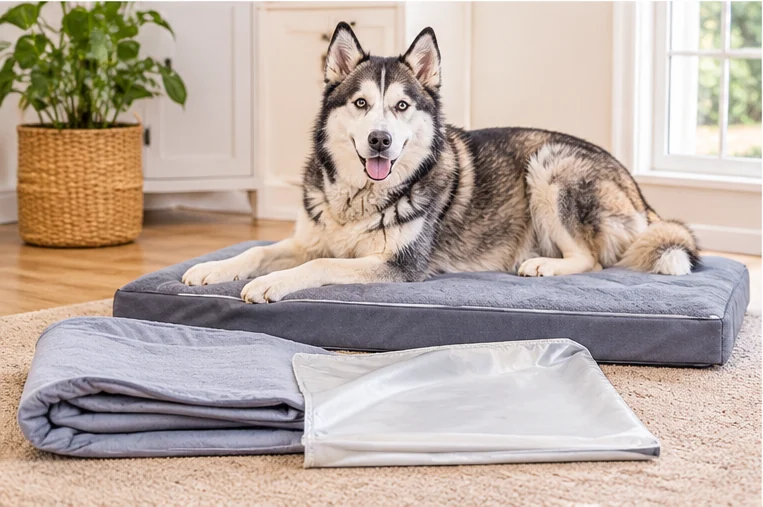
THE PRACTICAL GUIDE
Focus: what bed should a dog with IVDD sleep on, best bed for dog with IVDD
Is a flat, firm bed always best?
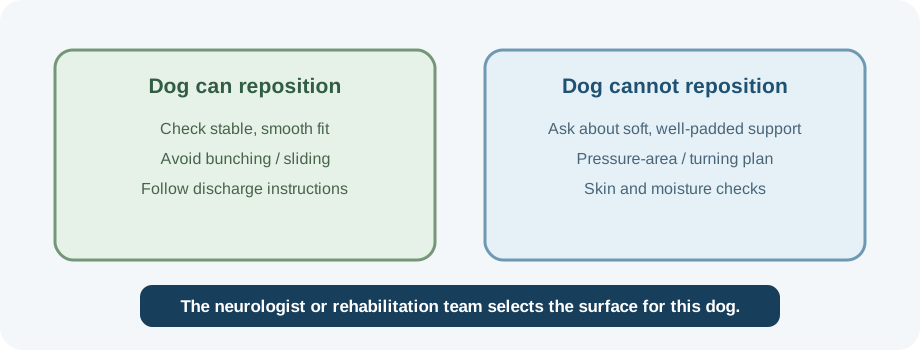
No. A flat pad can make crate fit and cleaning simpler, but it is not a universal prescription. ACVS notes that dogs who cannot turn themselves may develop pressure wounds and that a soft, well-padded area may help minimize or eliminate those wounds. The correct surface depends on neurologic function, skin condition and the clinician’s instructions.
What does a stable surface mean?
For a dog that can reposition, a practical surface should remain level, fit the crate and avoid loose layers that fold into ridges. The bed should support the dog’s natural resting posture without making the entry difficult. The care team may recommend a different cushion or positioning surface for a dog with more severe weakness.
Does a Dachshund need a longer bed?
Measure the actual dog while resting naturally and compare it with the bed’s usable sleeping dimensions. Breed labels and weight charts do not tell you the dog’s exact length. The surface should support the dog’s body without requiring the mattress to be folded or compressed into the crate.
Should the bed be waterproof?
Waterproof protection is particularly practical when the dog has urinary accidents or requires bladder expression. Use a fitted protector beneath a washable top cover, and change wet layers promptly. Do not allow damp bedding to remain against the skin.
What if the dog cannot stand or turn?
Ask the veterinarian or rehabilitation professional for specific instructions about cushioning, repositioning, skin checks and safe bedding changes. Do not choose a standard crate pad based only on online reviews.
What should the bed not do?
- It should not block the crate door or fold up at the corners.
- It should not create a high step that the dog cannot manage.
- It should not trap moisture against the dog’s skin.
- It should not require unsafe lifting to remove the cover.
For the two-path overview, read the IVDD recovery guide . For product specifications, see the IVDD bed buying guide .
Suggested buying options
The same set of publisher-supplied buying links is included throughout this guide. Use the links as a starting point, then verify the exact item, size, usable dimensions, entry height, materials, liner construction, cover care, seller, price and return terms on the destination page. They are comparison options, not a clinical ranking or a claim that a product treats or improves a medical condition.
Affiliate disclosure: IVDD Recovery Bed may earn a commission from a qualifying purchase through these links, at no additional cost to the reader. Commission availability does not determine editorial selection.
- Bedsure Orthopedic Dog Crate Bed Mat with Removable Machine Washable Cover — Black
- Frisco Orthopedic Pillow Cat & Dog Bed with Removable Cover — Navy Herringbone
- View IVDD bedding option 03
- View IVDD bedding option 04
- View IVDD bedding option 05
- View IVDD bedding option 06
Before buying, confirm that the listing is the intended product and that the dimensions and setup match your dog’s actual measurements and veterinary instructions.
Veterinary and reference sources
- American College of Veterinary Surgeons: Intervertebral Disc Disease
- ACVIM Consensus Statement: Diagnosis and Management of Acute Canine Thoracolumbar Intervertebral Disc Extrusion
- Cornell University College of Veterinary Medicine: Intervertebral Disc Disease
- Dachshund Club of America: Intervertebral Disc Disease
Sources provide clinical context. This site does not provide individualized medical advice or replace discharge instructions.