
THE PRACTICAL GUIDE
Focus: best dog bed for IVDD recovery, what bed should a dog with IVDD sleep on, IVDD crate rest setup
How are the two recovery paths different?
| Path | What determines the plan | Bedding questions |
|---|---|---|
| Surgical management | The operation performed, neurologic status, discharge instructions and follow-up plan. | What surface was recommended at discharge? Does the dog need help repositioning? Are bladder care or pressure-area precautions part of the plan? |
| Conservative management | A veterinarian’s decision that non-surgical management is appropriate for this dog, with a prescribed restriction and recheck plan. | What enclosure is required? How will the pad remain clean and dry? Does the dog need a special surface or assistance? |
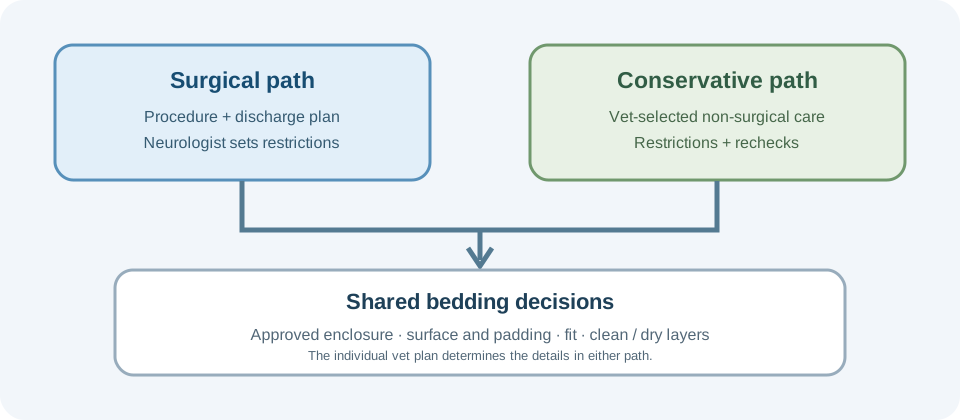
The American College of Veterinary Surgeons describes conservative management as an option for selected cases and notes that some dogs need bladder expression or additional skin and pressure-area care. The ACVIM consensus statement recommends at least four weeks of restricted activity for acute thoracolumbar disc extrusion, while also describing the evidence behind duration as limited. Your neurologist’s instructions—not a generic calendar—must guide the plan.
What bed features should you compare first?
- Correct fit: measure the crate interior and the dog’s actual resting footprint. Long-backed dogs may need a different pad length than weight charts suggest.
- Surface matched to mobility: a dog that can stand and reposition has different needs from a dog that cannot turn independently. Ask the care team whether a stable, flatter surface or a softer, more heavily padded surface is appropriate.
- Cleanable layers: removable covers and a spare set simplify changes when bedding becomes wet or soiled.
- Moisture protection: consider a waterproof protector when the dog has urinary accidents, needs bladder expression or has other moisture-related care needs.
- Safe transfer: choose a bed and cover that can be changed without unnecessary lifting, twisting or dragging.
Why is one surface not right for every IVDD dog?
“Flat and firm for every dog” is too simple. A dog that is weak but can reposition may need a stable surface that does not bunch. A dog that cannot turn independently may be at risk of pressure sores; ACVS notes that a soft, well-padded area may help minimize or prevent wounds. Ask the neurologist or rehabilitation professional to specify the right cushioning and repositioning plan for your dog.
How do you plan a week-by-week bedding setup?
Use the care team’s checkpoints rather than a universal week map. During the strictest prescribed confinement, keep the approved crate or restricted area and the current bedding stack consistent. At each recheck, ask whether the enclosure, pad or handling plan can change. A pen or larger room should not be introduced simply because a certain week has passed.
| Checkpoint | Bed-planning task | Ask the veterinary team |
|---|---|---|
| Discharge home | Set up the approved crate or restricted area, pad, protective layers and spare bedding. | What surface is right for the dog’s neurologic status? How should the dog be moved and toileted? |
| Ongoing rest | Keep the same footprint; replace wet or soiled layers carefully. | Does the dog need assisted turning, pressure-area checks or special bladder care? |
| Recheck | Do not enlarge the space or change the bed without approval. | Can the confinement setup change? What signs should trigger an earlier call? |
| After clearance | Choose a low-profile long-term bed and maintain household precautions advised by the vet. | What ongoing mobility and home-environment changes are recommended? |
Why is waterproof bedding especially relevant?
Some dogs with IVDD have difficulty urinating or cannot empty their bladder normally. ACVS notes that bladder expression may be needed for some patients, and that urine-related skin problems can occur. Waterproof protection can help keep the mattress dry, but it does not replace bladder-care instruction, skin checks or prompt bedding changes. A veterinarian or trained team member must demonstrate any bladder-expression technique; this site does not teach it.
What should dachshund owners measure?
Measure the dog’s natural lying footprint and the crate’s true interior dimensions. Do not assume a standard crate size or a generic weight chart will fit a long-bodied dog. The pad must fit without folding, bunching or blocking the door. See the Dachshund IVDD essentials checklist and bed-focused crate setup guide .
When should you contact a veterinarian urgently?
Follow the emergency instructions provided by your veterinarian. New or worsening weakness, inability to stand, severe pain, inability to urinate or a sudden change in function requires prompt veterinary contact. Do not wait for the next scheduled check because a bedding change seems to help.
Sources and scope
Clinical context is drawn from ACVS, the ACVIM consensus statement, Cornell and Dachshund Club of America resources. Product and bedding criteria are editorial selection guidance, not treatment advice.
Suggested buying options
The same set of publisher-supplied buying links is included throughout this guide. Use the links as a starting point, then verify the exact item, size, usable dimensions, entry height, materials, liner construction, cover care, seller, price and return terms on the destination page. They are comparison options, not a clinical ranking or a claim that a product treats or improves a medical condition.
Affiliate disclosure: IVDD Recovery Bed may earn a commission from a qualifying purchase through these links, at no additional cost to the reader. Commission availability does not determine editorial selection.
- Bedsure Orthopedic Dog Crate Bed Mat with Removable Machine Washable Cover — Black
- Frisco Orthopedic Pillow Cat & Dog Bed with Removable Cover — Navy Herringbone
- View IVDD bedding option 03
- View IVDD bedding option 04
- View IVDD bedding option 05
- View IVDD bedding option 06
Before buying, confirm that the listing is the intended product and that the dimensions and setup match your dog’s actual measurements and veterinary instructions.
Veterinary and reference sources
- American College of Veterinary Surgeons: Intervertebral Disc Disease
- ACVIM Consensus Statement: Diagnosis and Management of Acute Canine Thoracolumbar Intervertebral Disc Extrusion
- Cornell University College of Veterinary Medicine: Intervertebral Disc Disease
- Dachshund Club of America: Intervertebral Disc Disease
Sources provide clinical context. This site does not provide individualized medical advice or replace discharge instructions.